


National Team Profile
-
Overview
The Scotland men's national team represents Scotland in international football, and is governed by the Scottish Football Association. Scotland are jointly the oldest national football team in the world, sharing that distinction with England, against whom they played in the first ever international football match in 1872.
History
For the first half century of their existence, Scotland only played matches against the other Home Nations of England, Ireland and Wales, with matches against England carrying particular significance and a rivalry quickly developing. Though the Scottish Football Association joined FIFA in 1910, a dispute over amateur payments led the Home Nations to withdraw in 1928, meaning Scotland missed the first three World Cups.
After rejoining FIFA following the Second World War, Scotland became regular participants in international competition, though their record has often been one of near-misses and frustration. A famous 3–2 friendly victory over World Cup holders England at Wembley in 1967 briefly led fans to proclaim Scotland as "unofficial world champions", yet qualification for major tournaments remained inconsistent throughout the late 1960s and early 1970s.
Scotland's World Cup record has been a source of both pride and heartbreak. They qualified for four consecutive World Cups between 1974 and 1986, yet were eliminated at the group stage on each occasion — three times on goal difference alone. The 1978 campaign in Argentina proved particularly painful, as inflated expectations under manager Ally MacLeod gave way to defeats against Peru and Iran, before a stirring but ultimately insufficient 3–2 victory over the Netherlands. At the 1986 World Cup, Scotland managed just one point from their three group matches, losing to Denmark and West Germany before a frustrating goalless draw with Uruguay, who had a player sent off early in the game. Manager Alex Ferguson, who had taken charge on a caretaker basis following the death of Jock Stein, left the role after the tournament before taking over at Manchester United. To date, Scotland have appeared in eight World Cup finals and three European Championships, but have never progressed beyond the first round of any tournament.
Stadium
Hampden Park in Glasgow has served as the Scotland national football team's primary home ground since 1906, shortly after the stadium first opened. The current Hampden Park is the third ground to bear the name, and both of its predecessors also hosted Scotland matches. Throughout their history, Scotland have also played numerous home fixtures at other venues, in both friendly and competitive matches. Scotland hosted the very first official international football match on 30 November 1872 — a goalless draw against England — at the Hamilton Crescent cricket ground in Glasgow.
Hampden Park underwent significant redevelopment in the early 1990s to become an all-seater stadium in line with the Taylor Report, during which time Scotland played home matches at various other grounds including Ibrox, Pittodrie, Celtic Park and several others. The fully redeveloped stadium reopened in 1999 and has since hosted the vast majority of Scotland fixtures, with the occasional friendly moved to smaller venues such as Pittodrie or Easter Road.
Identity
Scotland traditionally wears dark blue shirts with white shorts and dark blue socks, which are the colours of the Queen's Park team who represented Scotland in the first international.
Scotland's supporters are known as The Tartan Army, and have earned recognition from several organisations for their friendly behaviour and charitable work. Tartan is a patterned cloth of criss-crossing coloured bands, most closely associated with Scotland, where it has long been used in traditional dress such as the kilt. The name came into common usage in the 1970s, originally describing the boisterous crowds at Hampden Park. Ahead of the 1998 World Cup, two Glasgow businessmen trademarked the name and commissioned an official tartan, which was registered in 1997.
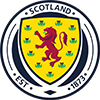
The current crest features a roundel — similar in style to the one used between 1961 and 1988 — enclosing a shield bearing the lion rampant and eleven thistles, the latter representing Scotland's national flower. The words "Scotland" and "Est 1873" appear at the top and bottom of the roundel respectively.
Rivalries
The rivalry between England and Scotland is the oldest in international football, dating back to the first ever official match in 1872 at Hamilton Crescent, Glasgow, which ended goalless. For Scottish supporters, defeating England carries particular significance, rooted in national pride and a long-standing sense of rivalry — reflected in the traditional Scottish sporting term for the English: the "Auld Enemy".
With 116 official meetings, England and Scotland have faced each other more frequently than any other two nations. England hold the superior overall record, having won 49 of those matches compared to Scotland's 41.